

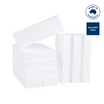
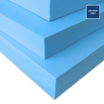
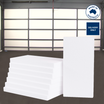


Insulation installed beneath a concrete slab is subjected to load while limiting heat transfer between the slab and the ground. The required R-value, compressive strength and exposure to moisture affect the choice of board. When sourcing under-slab insulation through The Foam Company, the choice between EPS and XPS should reflect those project requirements. Board type and thickness therefore depend on the conditions specified for the slab.
The EPS or XPS specified beneath a concrete slab needs properties that correspond to the conditions shown in the project design. Required thermal resistance establishes an R-value target, while the structural specification sets the compressive strength needed under load. Ground conditions also determine the level of moisture exposure. When you source rigid foam board through The Foam Company, those requirements give us the starting point for selecting under-slab insulation in Australia.
EPS vs XPS Under a Concrete Slab
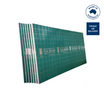
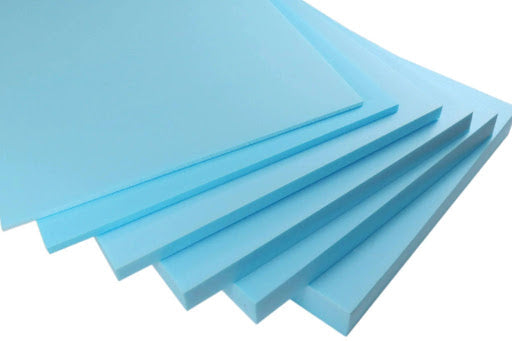
EPS and XPS are both polystyrene insulation, but their manufacturing processes produce different material structures. EPS is available in different densities, so EPS under-slab insulation needs to be selected by the properties of the particular grade. XPS has a closed-cell structure, with high compressive strength and moisture resistance that suit demanding underfloor applications.
That distinction answers a common project question: can EPS be used under a concrete slab? EPS is an option where the specified product satisfies the required load, moisture exposure and thermal performance. The comparison of EPS vs XPS under a concrete slab should therefore be made at product-grade level rather than material name alone.
For a practical specification:
- Use EPS where the nominated grade meets the slab's compressive and thermal requirements.
- Specify XPS under-slab insulation where its higher moisture resistance and strength suit the ground-contact conditions.
- Set board thickness from the required R-value and product data, rather than assuming either foam automatically provides the required thermal resistance.
Compressive Strength, Moisture and R-Value
A board underneath structural concrete remains under compression for the life of the slab. Compressive strength therefore needs to suit the load imposed by the slab and its design. Australian Government YourHome guidance states that insulation under slabs must have high compressive strength and resist moisture penetration and rotting; it also warns that compressed insulation loses insulating effectiveness and can contribute to structural failure.
Moisture is a separate specification issue. Ground contact exposes the insulation system to site conditions that differ from an internal wall or ceiling. XPS insulation under a concrete slab brings the moisture-resistant characteristics of its closed-cell structure to this position. EPS has its own closed-cell insulation properties, but the specified EPS grade still needs to satisfy the requirements of the slab assembly.
Under-Slab and Slab Edge Insulation
Heat does not leave a slab uniformly across its entire surface. YourHome reports that approximately 80% of slab heat loss occurs through the edge and notes National Construction Code requirements for slab-edge insulation in certain climate zones and where in-slab heating or cooling is installed.
That makes slab-edge insulation a separate part of the concrete slab insulation design. Perimeter insulation limits heat transfer at the exposed slab edge, while under-slab boards address heat transfer between the slab and ground. Climate and building design determine how those locations are treated, so insulating the underside without accounting for the perimeter leaves a different thermal pathway untreated.
Specifying EPS or XPS for the Slab
The best insulation under a concrete slab in Australia is the board whose declared properties satisfy the actual slab design at the specified thickness. If you are ordering foam for a concrete slab, establish the project requirements first:
- Confirm the required R-value and board thickness from the thermal design.
- Use the structural specification to establish the required compressive performance.
- Account for groundwater, drainage and other moisture conditions at the site.
- Check the slab area and slab-edge detail so the insulation quantity and placement reflect the drawings.
We supply EPS in different densities and XPS sheets for construction and insulation applications, with cut-to-size EPS available for project requirements. A polystyrene board should be selected because its documented properties suit its position beneath or around the slab, not simply because EPS or XPS has been nominated by name.
Speak with The Foam Company to find the right under-slab insulation for your project.




Leave a comment
This site is protected by hCaptcha and the hCaptcha Privacy Policy and Terms of Service apply.